

SHANGHAI, CHINA / ACCESS Newswire / August 16, 2026 / On August 14, dots studio, rednote’s model lab, released the model weights for dots3 note preview. The model belongs to the same dots3 series as the model that previously achieved a perfect score of 42 points at the 2026 International Mathematical Olympiad (IMO), and marks the first open-weight release in the dots3 series.
The model has 280B total parameters and 16B active parameters, supports a context window of up to 512K tokens, and offers multimodal understanding across text, vision, and audio. It has also been optimized for complex reasoning and long-horizon agent tasks. Across a range of mainstream benchmark results, dots3 – note preview ranks among the leading Chinese models of comparable size in reasoning, agent capabilities, and multimodal perception, with particularly strong visual capabilities among models of a similar size.
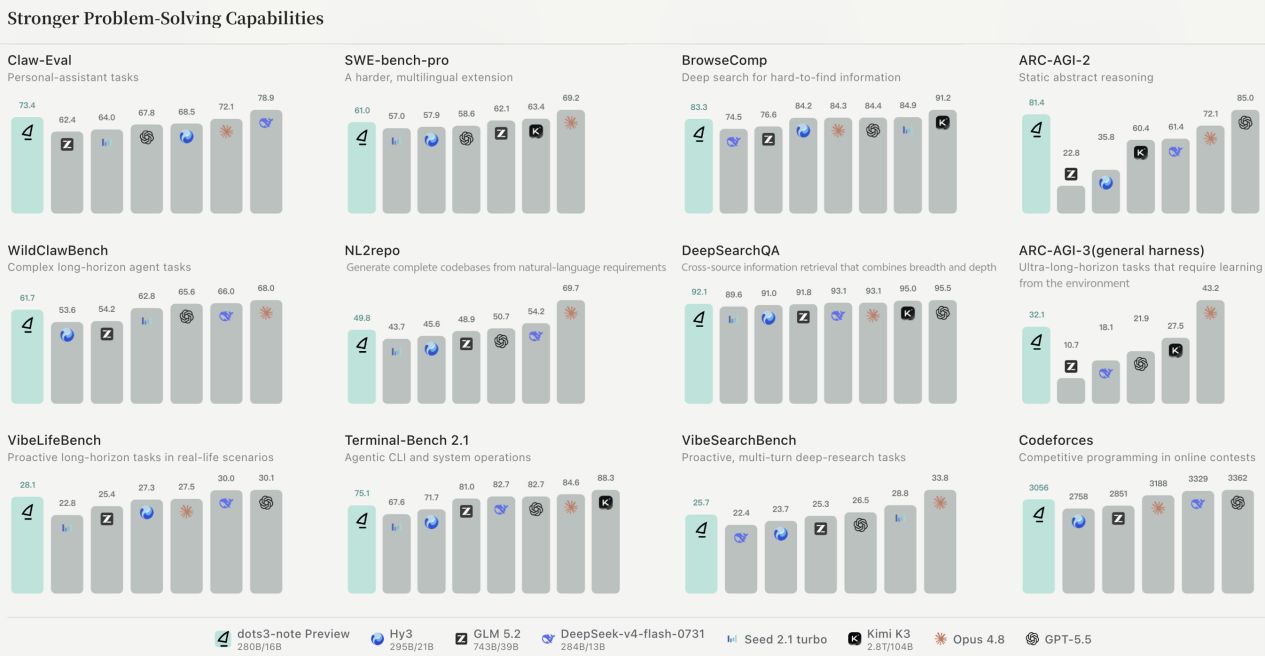
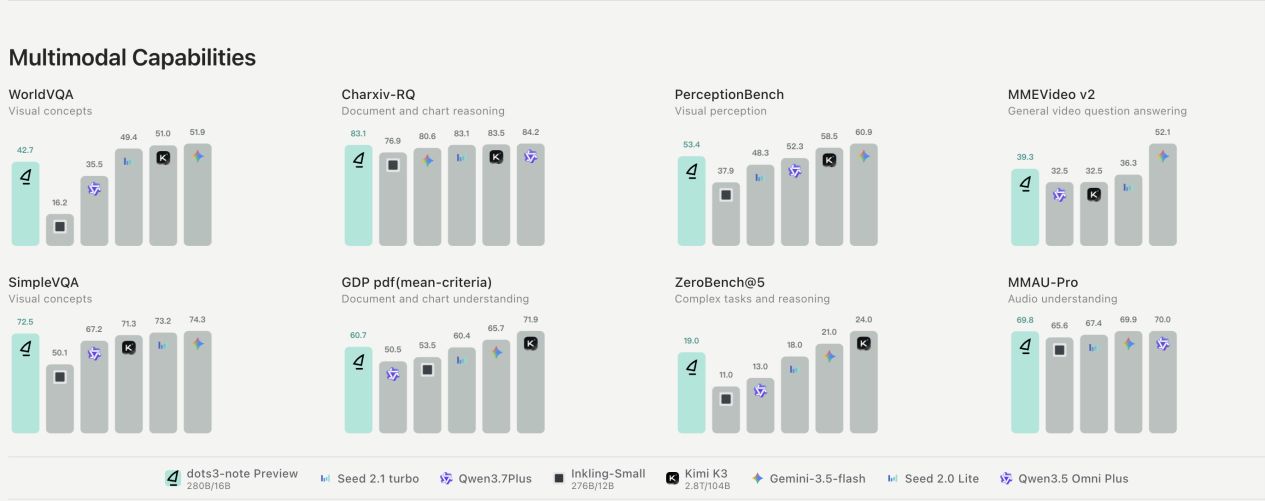
Figure: Evaluation results of dots3-note-preview on mainstream Benchmark
The team believes that long-horizon real-world tasks will become an important next frontier for advancing large-model capabilities, yet the industry has not paid enough attention to this area. The team previously introduced two benchmarks built around complex tasks in everyday-life scenarios. Leading models worldwide performed poorly on these evaluations, with none reaching the passing threshold. Through the open-weight release of dots3 note, the team hopes to share its latest technical thinking with the broader industry and encourage further exploration of this direction.
Over the past few years, large models have advanced rapidly on relatively closed-ended tasks such as mathematics, coding, and engineering. These tasks share an important characteristic: it is relatively easy to determine whether an answer is right or wrong, and models can receive clear feedback on how well they perform, making them easier to train and continuously improve.
Real-world tasks, however, are far more complex. Planning a trip, renovating a home, or organizing a wedding may unfold over days or even months. Users may not be able to articulate all of their constraints and preferences at the outset, while external factors such as price fluctuations, flight changes, and changing weather conditions may emerge along the way.
As a result, models need not only to understand information beyond text, including images and audio, but also to continuously assess whether their current plans are effective throughout long-horizon tasks and improve them along the way, rather than waiting until the end to determine success or failure.
dots studio focuses on improving large models’ performance on long-horizon real-world tasks. This aligns with the studio’s mission to “Create frontier intelligence for daily life,” while continuing rednote’s longstanding focus on everydaylife scenarios and its belief in using technology to benefit ordinary people.
The newly released dots3 – note preview represents the latest progress in dots studio’s efforts to build agents capable of handling long-horizon real-world tasks. Across multiple reasoning and agent tasks, the model can match or even outperform much larger models with several times its parameter count.
To address the challenges of real-world tasks, the technical approach behind dots3 – note preview focuses on three areas: First, stronger multimodal understanding. Information in everyday-life scenarios is not limited to text. Floor plans, quotations, flight screenshots, maps, and voice memos all contain complex forms of information that a model needs to understand before it can effectively handle real-world tasks.
Second, the introduction of self-critiquing. Long-horizon tasks cannot rely solely on sparse rewards at the end of a trajectory. During RL training, the team trains the model not only to solve problems, but also to evaluate its own progress along the way. By learning to critique intermediate states-identifying mistakes, reassessing its hypotheses, and estimating whether it is on the right track-the model receives richer learning signals throughout long trajectories, enabling a more scalable reinforcement learning paradigm.
The same self-critiquing capability can also be scaled at inference time. Rather than relying on a single attempt, the model can iteratively review and refine its own solutions. At IMO 2026, this approach demonstrated its potential: through iterative self-critiquing, the dots3 note series achieved an officially certified perfect score of 42/42 and a gold medal.
Third, TEMPO and long-horizon reinforcement learning. For tasks that last for weeks or even longer, conventional reinforcement learning struggles to accurately attribute a final outcome to each intermediate decision: task trajectories are too long, while meaningful feedback is too sparse. To address this bottleneck, the team developed TEMPO, which demonstrated stronger performance than GRPO on ARC-AGI 3.
Real-world tasks are difficult to measure using existing benchmarks. To address this, the team developed two evaluation frameworks.
One of them, VibeSearchBench, primarily evaluates a model’s multi-turn search capabilities as users’ needs gradually become clearer. It covers 20 domains and 200 tasks, simulating different user personas and requiring models to progressively identify and fill in missing requirements through multiple rounds of interaction.
The other evaluation framework, VibeLifeBench, focuses on whether a model can follow through on tasks over extended periods in a continuously changing environment. It simulates the passage of real time as well as external changes such as prices and service status. The evaluation covers 10 domains and 20 long-horizon tasks, with each task spanning 20 to 30 stages and a total of 1,247 evaluation checks.
Current results suggest that leading models still have substantial room for improvement on both evaluations. On VibeLifeBench, for example, all seven leading models tested fell below the passing threshold, with Claude Opus 5 ranking first at 0.325. On VibeSearchBench, Claude Opus 5 led with a score of 31.14, while GPT-5.4 ranked last.
These results also suggest that, as models move from verifiable tasks toward real-world tasks, their capabilities still face significant challenges.
The full version of dots3 note is also expected to be released with open weights in the near future. dots3 note is the lightest version in the dots 3 series, and the complete dots3 series will include three tiers-note, jazz, and aria-designed for applications with different requirements for task complexity, response speed, and compute cost. dots has previously released the model weights for the text large language model dots.llm1, the multilingual document layout parsing model dots.ocr, and the multimodal visual understanding large model dots.vlm1.
Tech blog: https://studio.dots.ai/dots/dots3-en.html
HuggingFace: https://huggingface.co/dots-studio/dots3-note-prev
dots studio website: https://studio.dots.ai/?lang=en
Company: dots studio (rednote/Xiaohongshu)
Contact: Chao Qiao
Email: dots-model-feedback@xiaohongshu.com
Website: https://studio.dots.ai/?lang=en
SOURCE: Dots Studio (rednote/Xiaohongshu)
View the original press release on ACCESS Newswire
